Tuesday, March 27, 2007
Finally the "I" word has been mentioned officially for Kosovo. Today Ahtisaari unveiled his plan for Kosovo and after avoiding now, as expected, mentions that Kosovo should be given independence. The hesitancy over the past seven years to name future status of Kosovo this explicitly has been understandable, but also gave unrealistic hope to the Serbian elite that anything else was an option. At this point, unfortunately, it still looks like Serbian authorities will be busier preventing the decision in the Sec. Council and any implementation, rather than making the best of the offer and the extensive minority rights protections offered in the package.

Wednesday, March 21, 2007
Where's Veljko?

A few years ago when looking to rent a flat in Belgrade, we nearly rented from Veljko Kadijevic daughter-in-law. She shared her outrage with us that he was wrongly maligned as the last minister of defense of Yugoslavia. Apparently the USA agrees.
As Blic reports, he is living in Florida, advising the Pentagon in Iraqi bunkers these days. Wasn't that the same Kadijevic who was raving about the 'foreign factors' destroying Yugoslavia ...

A few years ago when looking to rent a flat in Belgrade, we nearly rented from Veljko Kadijevic daughter-in-law. She shared her outrage with us that he was wrongly maligned as the last minister of defense of Yugoslavia. Apparently the USA agrees.
As Blic reports, he is living in Florida, advising the Pentagon in Iraqi bunkers these days. Wasn't that the same Kadijevic who was raving about the 'foreign factors' destroying Yugoslavia ...
Wednesday, March 14, 2007

In Sarajevo last week I noticed that Vucko posters in town to remind of the Winter Olympics. The International Olympic Committee has possibly the best description of this little furry wolf with the howl which seems to call for cough-drops:
"Vuchko", the tough and courageous wolf. This mascot helped to change the traditionally frightening and bloodthirsty image of the wolf, which is present in the region. This wolf has both a serious and a cheerful side, but is happy rather than serious. It symbolises the desire of human beings to make friends with animals, to make a wolf into a Vuchko.
Wednesday, March 07, 2007
Friday, March 02, 2007

Wednesday, February 07, 2007
Yesterday Paddy Ashdown gave a lecture here in at the University of Kent. He spoke only little on Bosnia, but instead offered both a biting critique of unilateral intervention a la Iraq and an equally staunch defense of intervention in Bosnia and other countries, if done multilaterally.
Most interesting was his lessons learned from intervention, some already generally accepted in the policy community such as rule of law first, elections second, others, although obvious, were more instructive, such as don't model the country on (an idealized version of) your own country. A number of these lessons seem to be the result of reflecting after his mission as HR in Bosnia. In particular, he favors the abolition of the Bonn powers and movement towards greater self-governance in Bosnia. Considering that he was arguably the most interventionist high rep, the call for less intervention should be instructive for current discussions on extending the mandate of the OHR in Bosnia.
Most interesting was his lessons learned from intervention, some already generally accepted in the policy community such as rule of law first, elections second, others, although obvious, were more instructive, such as don't model the country on (an idealized version of) your own country. A number of these lessons seem to be the result of reflecting after his mission as HR in Bosnia. In particular, he favors the abolition of the Bonn powers and movement towards greater self-governance in Bosnia. Considering that he was arguably the most interventionist high rep, the call for less intervention should be instructive for current discussions on extending the mandate of the OHR in Bosnia.
Saturday, February 03, 2007
Wednesday, January 31, 2007
Gloomy?
When discussing the Western Balkans with analysts and policy makers, one can notice distinct mood shifts over the years. In some cases is might be just because you are at a gathering of optimists or pessimists, in other cases it has little to do with the situation in the countries, as it might be the case of dissapointed internatioanl (false) expections or what is bad in one country does not necessarily bode ill for another.
Be this as it may, it was striking to note the worried atmosphere at a meeting last week in Paris of EU policy makers and analysts. After 2006 seemed like a year where transition from post-conflict to European integration would be more tangible, little was decided. Now 2007 might be overwhelmed by the legacy of 2006. Both the status decision for Kosovo and the shutting down of the OHR in Bosnia appears already to be too much in one go. So, local 'ownership', the buzzword of a few years back has fallen in popularity. It appears that the future EU mission in Kosovo will be similar to the OHR including the Bonn-powers (to dimiss officials and pass legislation) and since the current High Rep. Schwarz Schilling is leaving early and even he noted the continued need for the OHR, full souvereignty to Bosnia also seem to be not forthcoming any time soon. To a large degree, the talk of an independence referendum of the Serb Republic by Milorad Dodik is to blame. Ironically, one of the politicians the most critical of the international community and of the OHR in particular has thrown it another life-line.
Whether the OHR will remain effective and it's decision legitimate remains to be seen. It is an emperor without clothes and if it is called on its weakness, there might be difficulties ahead. A few years back, a good part of Bosnian citizens supported an increase in the power of the OHR, in 2006 the UND early warning report notes that supporters of reducing the OHR's competences are larger than those who would like to increase it among all three national communities. Similarly in Kosovo, there is a question whether such a type of mission will be legitimate and accepted, especially as the status solution is unlikely to satisfy anybody fully.
Finally, as there is a sense that EU enlargement might be slowed down and not because of the countries in the region, but because of the EU's current internal crisis, the key carrot might be loosing some of its pull.
Altogether, the meeting left me thinking that despite some key decisions being taken in 2007, stability remains at risk and we might have to wait for 2008 for more courageous steps towards EU Integration of the region.
When discussing the Western Balkans with analysts and policy makers, one can notice distinct mood shifts over the years. In some cases is might be just because you are at a gathering of optimists or pessimists, in other cases it has little to do with the situation in the countries, as it might be the case of dissapointed internatioanl (false) expections or what is bad in one country does not necessarily bode ill for another.
Be this as it may, it was striking to note the worried atmosphere at a meeting last week in Paris of EU policy makers and analysts. After 2006 seemed like a year where transition from post-conflict to European integration would be more tangible, little was decided. Now 2007 might be overwhelmed by the legacy of 2006. Both the status decision for Kosovo and the shutting down of the OHR in Bosnia appears already to be too much in one go. So, local 'ownership', the buzzword of a few years back has fallen in popularity. It appears that the future EU mission in Kosovo will be similar to the OHR including the Bonn-powers (to dimiss officials and pass legislation) and since the current High Rep. Schwarz Schilling is leaving early and even he noted the continued need for the OHR, full souvereignty to Bosnia also seem to be not forthcoming any time soon. To a large degree, the talk of an independence referendum of the Serb Republic by Milorad Dodik is to blame. Ironically, one of the politicians the most critical of the international community and of the OHR in particular has thrown it another life-line.
Whether the OHR will remain effective and it's decision legitimate remains to be seen. It is an emperor without clothes and if it is called on its weakness, there might be difficulties ahead. A few years back, a good part of Bosnian citizens supported an increase in the power of the OHR, in 2006 the UND early warning report notes that supporters of reducing the OHR's competences are larger than those who would like to increase it among all three national communities. Similarly in Kosovo, there is a question whether such a type of mission will be legitimate and accepted, especially as the status solution is unlikely to satisfy anybody fully.
Finally, as there is a sense that EU enlargement might be slowed down and not because of the countries in the region, but because of the EU's current internal crisis, the key carrot might be loosing some of its pull.
Altogether, the meeting left me thinking that despite some key decisions being taken in 2007, stability remains at risk and we might have to wait for 2008 for more courageous steps towards EU Integration of the region.
Sunday, January 28, 2007
Last Monday, I participated in a discussion on the status of Kosovo and its implications at LSE. What was striking beside the apparently large interest in the topic was the diaspora mobilization. As a result, it was more controversial and difficult to talk calmly about some issues, such as conditional independence, than in Belgrade (or Prishtina). I guess abroad there are more people who see their role as "professionally" defending what they think their nations' interest is.
Globe and Mail, 19.1.2007
Fate of Serbian reform hinges on vote
PRAGUE -- Serbs go to the polls Sunday in an early election to decide whether the country continues along its plodding path toward Western integration, accelerate the pace of reform or slide back toward radical nationalism. And the wild card in the race will be voter turnout.
Beware of university cafeterias. More than once in recent history have they been the source of protest and unrest. The mention that the confrontation between supporters of Hizbollah and other opposition groups and government followers began in the cafeteria of the Beirut Arab University. This reminds me of the 1981 demonstrations and riots in Kosovo which also began in the university cafeteria over bad food and later demanded the status of republic for Kosovo.
Solution: Close down university cafeteria in troubled times... or maybe serve such good food that nobody can complain.
Solution: Close down university cafeteria in troubled times... or maybe serve such good food that nobody can complain.
Friday, July 14, 2006
To quote the Montenegrin daily Republika, "Biber trazi promjene" [Biber asks for changes], I will now start writing with East Ethnia. Enjoy and looking forward to your comments there.
Monday, March 20, 2006
Don't cry for me Serbia...
On Saturday, I stopped by the 'meeting' to commemorate the death of Miloesvic in front of the Parliament of Serbia and Montenegro. Although the numbers were impressive (80,000 according to police, 500,000 according to SPS), the gathering was pretty pathetic. The atmosphere was too pathetic for a meeting or protest, and too angry for a funeral.
Particularly striking were the women who cried at the manifestation for Milosevic’s funeral not for Slobo, but for themselves. They cried over their own misery and poverty. The tragedy lies in the fact that they do not realize that the one they are formally crying for is the one mostly responsible for their misery.
On Saturday, I stopped by the 'meeting' to commemorate the death of Miloesvic in front of the Parliament of Serbia and Montenegro. Although the numbers were impressive (80,000 according to police, 500,000 according to SPS), the gathering was pretty pathetic. The atmosphere was too pathetic for a meeting or protest, and too angry for a funeral.
Particularly striking were the women who cried at the manifestation for Milosevic’s funeral not for Slobo, but for themselves. They cried over their own misery and poverty. The tragedy lies in the fact that they do not realize that the one they are formally crying for is the one mostly responsible for their misery.
Saturday, February 18, 2006
Here's a short
interview with Gradjanski List on Kosovo, Montenegro and other
easy topics. The English version will be available soon.
interview with Gradjanski List on Kosovo, Montenegro and other
easy topics. The English version will be available soon.
Wednesday, February 08, 2006
Monday, February 06, 2006
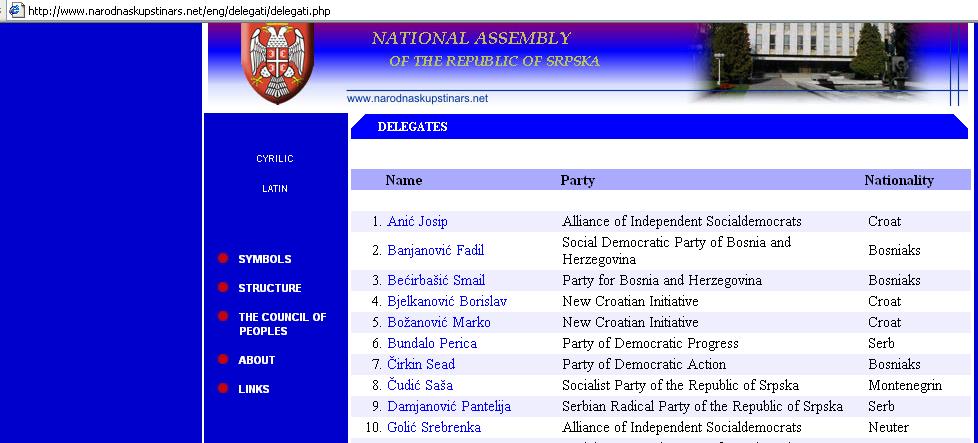
It turns out that Sali Berisha plagiarized a speech from his much beloved predecessor Fatos Nano (as if talking about "solving the system of equations" wouldn't give it away). Coincidentally, I found out recently from a colleague that a draft constitution of an unnamed African country plagiarized its neighbors constitutions. Hmm, how could one punish governmental plagiarism? Maybe there should be an EU guideline against state plagiarism, but then how would candidate countries adopt all this acquis communitaire...
Friday, January 27, 2006

Tuesday, January 10, 2006
György Spiró has discovered the EU Commission for European Standards guidelines for writing a novel. It contains gems such as Art. 13 D):
"Positive Main Characters recommended exceptionally strongly:
a) A grandmother who underwent many terrible tribulations before the advent of the EU with her spiritual and moral integrity remaining intact, and who now educates her grandchildren single-handedly in such a manner that they become upright, law-abiding citizens of the European Union who meet the challenges of business life."
or
Art. 5 & 6:
5) The Novel must contain Dialogue and Author's Text. A work lacking either of these will not qualify as a Novel and will not be supported.
6) The ideal ratio between Dialogue and Author's Text is 2 : 1. A maximum divergence of + or 12 per cent is tolerable. Any divergence of a larger order will result in the disqualification of the work from European Union support.
http://www.eurozine.com/articles/2005-10-03-spiro-en.html
"Positive Main Characters recommended exceptionally strongly:
a) A grandmother who underwent many terrible tribulations before the advent of the EU with her spiritual and moral integrity remaining intact, and who now educates her grandchildren single-handedly in such a manner that they become upright, law-abiding citizens of the European Union who meet the challenges of business life."
or
Art. 5 & 6:
5) The Novel must contain Dialogue and Author's Text. A work lacking either of these will not qualify as a Novel and will not be supported.
6) The ideal ratio between Dialogue and Author's Text is 2 : 1. A maximum divergence of + or 12 per cent is tolerable. Any divergence of a larger order will result in the disqualification of the work from European Union support.
http://www.eurozine.com/articles/2005-10-03-spiro-en.html
The German state of Baden Württemberg introduced a "guiding" questionnaire for applicants for German citizenship. The questionnaire has been criticized by the Greens and others for being biased, as most questions appear to be focusing particular on the Muslim community and making personal views ("Gesinnung") a
criteria for citizenship.
I think the problem is not so much the questions, they are less problematic than some countries asking for cooking recipes as criteria of citizenship. I am just wondering how many "good Germans" would answer questions such as "Imagine your adult son tells you he is gay and wants to live with another man. How do you react?" or "Your daughter applies for a job in Germany. She is rejected while the job was offered to a black African from Somalia. How do you react?" in the desired way. What is the right answer to become an average German (or average West European in general)?
For the full list in German see the following link from the Frankfurter Allgemeine Zeitung

Subscribe to:
Posts (Atom)
