To quote the Montenegrin daily Republika, "Biber trazi promjene" [Biber asks for changes], I will now start writing with East Ethnia. Enjoy and looking forward to your comments there.
Friday, July 14, 2006

Monday, March 20, 2006
Don't cry for me Serbia...
On Saturday, I stopped by the 'meeting' to commemorate the death of Miloesvic in front of the Parliament of Serbia and Montenegro. Although the numbers were impressive (80,000 according to police, 500,000 according to SPS), the gathering was pretty pathetic. The atmosphere was too pathetic for a meeting or protest, and too angry for a funeral.
Particularly striking were the women who cried at the manifestation for Milosevic’s funeral not for Slobo, but for themselves. They cried over their own misery and poverty. The tragedy lies in the fact that they do not realize that the one they are formally crying for is the one mostly responsible for their misery.
On Saturday, I stopped by the 'meeting' to commemorate the death of Miloesvic in front of the Parliament of Serbia and Montenegro. Although the numbers were impressive (80,000 according to police, 500,000 according to SPS), the gathering was pretty pathetic. The atmosphere was too pathetic for a meeting or protest, and too angry for a funeral.
Particularly striking were the women who cried at the manifestation for Milosevic’s funeral not for Slobo, but for themselves. They cried over their own misery and poverty. The tragedy lies in the fact that they do not realize that the one they are formally crying for is the one mostly responsible for their misery.
Saturday, February 18, 2006
Here's a short
interview with Gradjanski List on Kosovo, Montenegro and other
easy topics. The English version will be available soon.
interview with Gradjanski List on Kosovo, Montenegro and other
easy topics. The English version will be available soon.
Wednesday, February 08, 2006
Monday, February 06, 2006
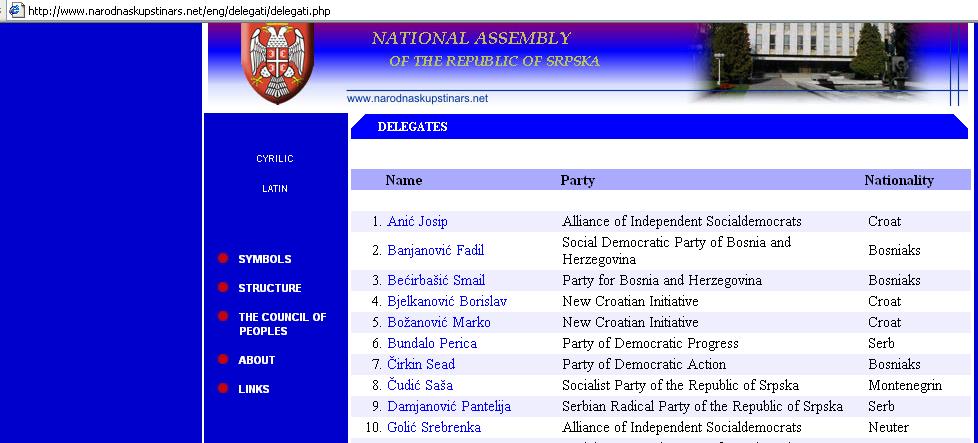
It turns out that Sali Berisha plagiarized a speech from his much beloved predecessor Fatos Nano (as if talking about "solving the system of equations" wouldn't give it away). Coincidentally, I found out recently from a colleague that a draft constitution of an unnamed African country plagiarized its neighbors constitutions. Hmm, how could one punish governmental plagiarism? Maybe there should be an EU guideline against state plagiarism, but then how would candidate countries adopt all this acquis communitaire...
Friday, January 27, 2006

Tuesday, January 10, 2006
György Spiró has discovered the EU Commission for European Standards guidelines for writing a novel. It contains gems such as Art. 13 D):
"Positive Main Characters recommended exceptionally strongly:
a) A grandmother who underwent many terrible tribulations before the advent of the EU with her spiritual and moral integrity remaining intact, and who now educates her grandchildren single-handedly in such a manner that they become upright, law-abiding citizens of the European Union who meet the challenges of business life."
or
Art. 5 & 6:
5) The Novel must contain Dialogue and Author's Text. A work lacking either of these will not qualify as a Novel and will not be supported.
6) The ideal ratio between Dialogue and Author's Text is 2 : 1. A maximum divergence of + or 12 per cent is tolerable. Any divergence of a larger order will result in the disqualification of the work from European Union support.
http://www.eurozine.com/articles/2005-10-03-spiro-en.html
"Positive Main Characters recommended exceptionally strongly:
a) A grandmother who underwent many terrible tribulations before the advent of the EU with her spiritual and moral integrity remaining intact, and who now educates her grandchildren single-handedly in such a manner that they become upright, law-abiding citizens of the European Union who meet the challenges of business life."
or
Art. 5 & 6:
5) The Novel must contain Dialogue and Author's Text. A work lacking either of these will not qualify as a Novel and will not be supported.
6) The ideal ratio between Dialogue and Author's Text is 2 : 1. A maximum divergence of + or 12 per cent is tolerable. Any divergence of a larger order will result in the disqualification of the work from European Union support.
http://www.eurozine.com/articles/2005-10-03-spiro-en.html
The German state of Baden Württemberg introduced a "guiding" questionnaire for applicants for German citizenship. The questionnaire has been criticized by the Greens and others for being biased, as most questions appear to be focusing particular on the Muslim community and making personal views ("Gesinnung") a
criteria for citizenship.
I think the problem is not so much the questions, they are less problematic than some countries asking for cooking recipes as criteria of citizenship. I am just wondering how many "good Germans" would answer questions such as "Imagine your adult son tells you he is gay and wants to live with another man. How do you react?" or "Your daughter applies for a job in Germany. She is rejected while the job was offered to a black African from Somalia. How do you react?" in the desired way. What is the right answer to become an average German (or average West European in general)?
For the full list in German see the following link from the Frankfurter Allgemeine Zeitung
Sunday, January 08, 2006

Wednesday, December 21, 2005

Tuesday, December 20, 2005
I admit that writing a letter to the editor for the Washington Times is like writing a policy brief to Rumsfeld telling him that the war in Iraq was a bad idea and hoping for change. Anyhow, I did write one following a particularly disturbing opinion piece on Bosnia, which hit on all the themes any nationalist publication in Serbia would be proad of: The Islamist-terrorist threat, the artificial nature of multiethnic states and the threat through centralization to Serbs and Croats.
The letter can be read at:
http://www.washtimes.com/op-ed/ed-letters.htm
The original article "Islamist State in Europe" with such memorable lines as "The Croatians are dying" is available at:
http://washingtontimes.com/commentary/20051218-125507-6951r.htm
The letter can be read at:
http://www.washtimes.com/op-ed/ed-letters.htm
The original article "Islamist State in Europe" with such memorable lines as "The Croatians are dying" is available at:
http://washingtontimes.com/commentary/20051218-125507-6951r.htm
Monday, December 05, 2005

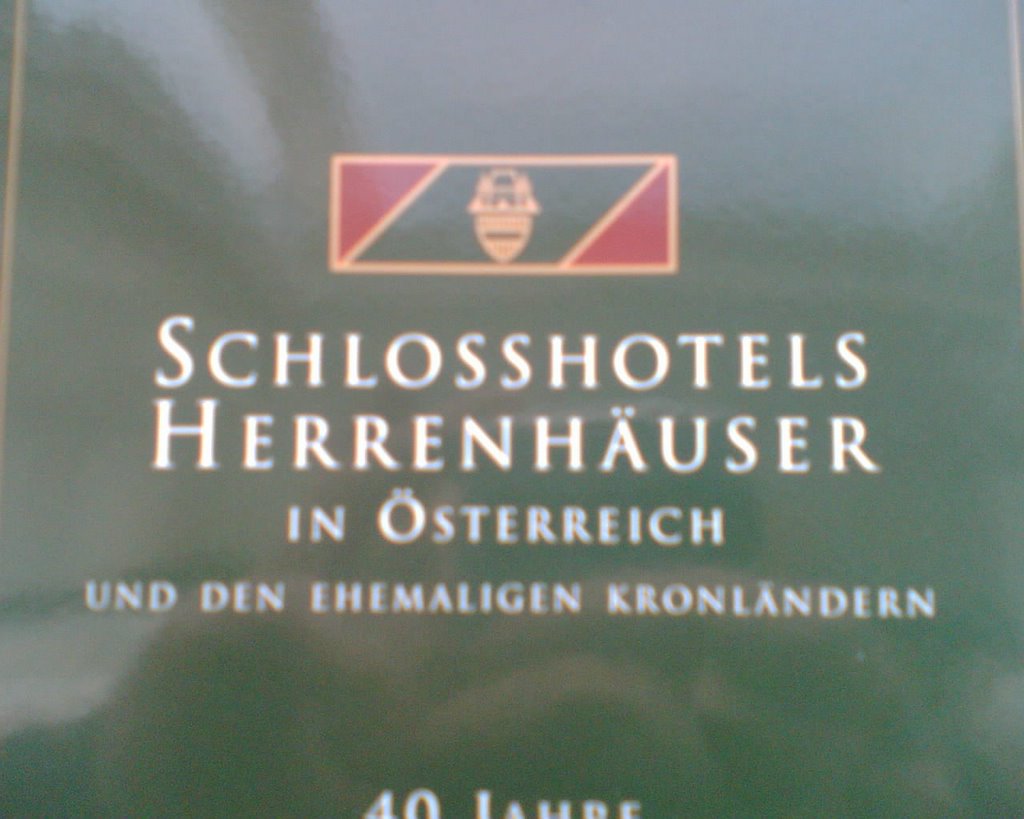
Staying in the wonderful Altstadt Hotel in Vienna, I noticed that the hotel belongs to a chain of hotels with branches in Austria and "the former crown lands". What about some similar chains. German hotels in Breslau, Königsberg and other former territories of the reich, or a nice little Turkish hotel group with boutique hotels in Turkey and the former Ottoman sanjaks, including in Athens, Belgrade and Sofia.
The options seems endless and a great marketing ploy.
During the Bosnian war, bus tour operators in Vienna were advertising trips to Medjugorje and Orange picking in the Neretva valley in a former Austro-Hungarian crown land--Bosnia was mentioned nowhere, for good reason.
Tuesday, November 22, 2005
Monday, November 21, 2005
On the occassion of the 10 year anniversary of the Dayton Peace Accords, I am glad to announce the publication of my study of post-war governance of Bosnia, published with Palgrave in the UK. The book discusses in detail how Dayton has shaped institutions in Bosnia, the attempts at overcoming the legacy of the war and evolution of Bosnia over the past decade.
If you are interested in sample chapters or more detailed information, don't hesitate to contact me at bieberf at gmx.net
I apologise for the high price of 45 Pounds (it's still less than 25 pence per page).
Florian Bieber
Post-War Bosnia: Ethnicity, Inequality and Public Sector Governance
London: Palgrave, 2006. pp. 176 + xvi.
Florian Bieber
http://www.amazon.co.uk/exec/obidos/ASIN/1403998825/balkanacademi-21/202-8610048-1415019?creative=6394&camp=1406&link_code=as1

http://www.palgrave.com/products/Catalogue.aspx?is=1403998825
Ten years after the end of the war, ethnicity in Bosnia continues to matter and the country remains dependent on international intervention. The Dayton Peace Accords signed in 1995 successfully ended the war, but froze the ethnic conflict in one of the most complex systems of government in the world. The book provides an in-depth analysis of governance in this divided post-war country, providing important lessons for international intervention elsewhere around the world, from Afghanistan to Iraq.
Contents
Front Matters
Introduction
Historical Legacies
Cleavages and Inequalities in Post-War Bosnia
Governance and Administration in Bosnia
The Record of the Post-Dayton Elections
Addressing Inequality & Reforming Governance in Post-war Bosnia
Conclusions
Appendice
Notes
Bibliography
Index
'An informative study of the special challenges of governance, stabilization and European integration in Bosnia and Herzegovina. It will be useful to scholars and policymakers alike.' - Sumantra Bose, London School of Economics and Political Science, UK
'Bieber's exemplary study of Bosnia and Herzegovina...is based on extensive research, in-depth knowledge, and a remarkably balanced view of the achievements and shortcomings of the international overlords. Bieber presents a convincing contribution to the debate on how to turn this experiment in state building into a truly self-sustaining democratic and multi-ethnic Bosnia.' - Wolfgang Petritsch, High Representative for Bosnia and Herzegovina, 1999-2002
Monday, November 07, 2005

Thursday, November 03, 2005
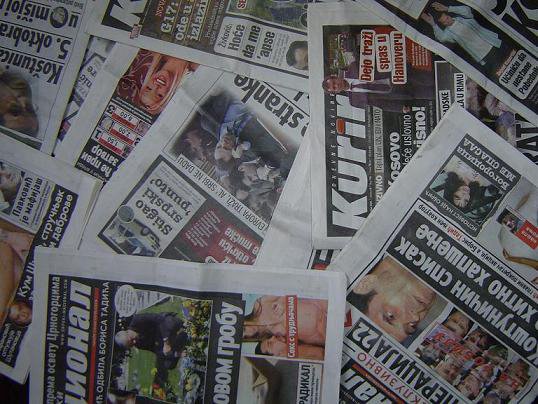
Here's some evidence that reading is not always a good thing... I read only Kurir and Srpski Nacional, two Serbian tabloids for a week. What this lead to, read
Super Kurir Me on TOL.
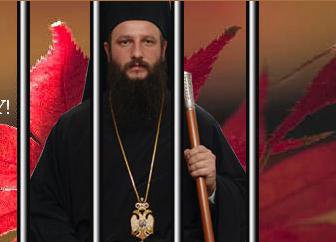
In a sentimental piece about Ashdown leaving Bosnia soon, the Guardian describes him as having "assumed an authority which has been compared to that of a medieval pope." It is important to emphasize the word 'medieval', as the concept of Papal Infallibility was only introduced in 1870.
Telling is when Ashdown notes that his biggest failure was the fact that "is that although we have created institutions, we have not created a civil society." He made a similar remarked at a recent conference on the 10 year anniversary of Dayton in Geneva. I guess that as long as outsiders try to 'create' a civil society in Bosnia or elsewhere, we're in trouble.
Telling is when Ashdown notes that his biggest failure was the fact that "is that although we have created institutions, we have not created a civil society." He made a similar remarked at a recent conference on the 10 year anniversary of Dayton in Geneva. I guess that as long as outsiders try to 'create' a civil society in Bosnia or elsewhere, we're in trouble.
Wednesday, November 02, 2005
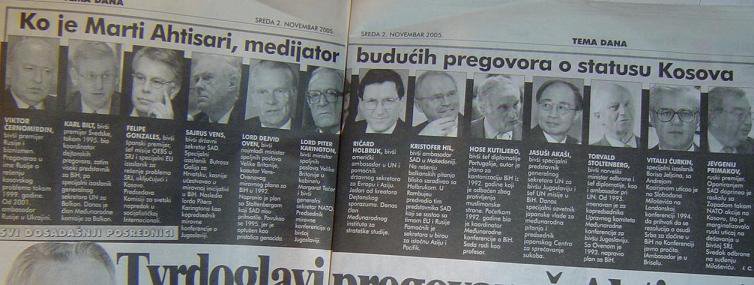
Blic published today a nice little list of all the international negotiators Serbia and ex-Yu has seen come and go (and in some cases come back again). Some forgotten (does anyone remember Vitalji Churkin's efforts) others more prominent.
Any further additions to the list welcome.
No. 1: Jacques Poos, the foreign minister of Luxembourg who uttered those famous words about the hour of Europe dawning.
Subscribe to:
Posts (Atom)
