The Borders of the European Union
Zagreb, 1. June 2011
With big fireworks in Zagreb and along the Hungarian and Slovene border, Croatia welcomed the opening of the border to the European Union and Croatia joining the Schengen zone. While free travel to the EU was never a problem for citizens of Croatia, the abolition of border posts to Hungary and Slovenia marks a great improvement for border communities, especially those which saw the hardening of the border when Slovenia joined the Schengen area back in 2008. The president of the European Union, Jean-Claude Juncker, congratulated Croatia on this historical step.
A little east from Croatia, however, political development in recent years suggest the European Union has failed to bring stability. Ever since the illegal referendum on independence of Republika Srpska in late 2010 Bosnia has de facto ceased to exist. The referendum followed the defeat of prime minister Dodik in 2010 by the candidate of the Serb Radical Party, supported by Belgrade and the closure of the OHR in 2009. The predominantly Bosniak and Croat Federation claims to represent all of Bosnia and rejects the declaration of independence of the Serb Republic, which has to date only be recognized by Serbia and Russia.
While reforms have accelerated in the Federation, the Bosniak member of the Bosnian presidency has recently accused the Croat party of being willing to sacrifice the claim on the Serb Republic for quick entry into the EU. Some Bosniak parties have in fact altogether challenged the EU membership, suggesting that the EU wants to break up Bosnia. This statement comes after the EU insisting that only a unified Bosnia can join the European Union. Considering the strong rejection of EU membership at this point by the Serb Radical Party, in power in Belgrade and Banja Luka, such a perspective appears unrealistic.
While the electoral success of the Radical Party in Serbia itself back in 2008 did not lead to a fully fledged roll-back of reforms in Serbia, the country has been increasingly polarized and the economy has stagnated. Besides the agreement that Lada would begin building cars in Serbia's Zastava car factor, few large foreign investments have materialized.
The proposal by the EU to establish a new partnership agreement with Serbia recently was welcomed by Serbian President Tomislav Nikolic, but rejected as long as the EU proposed agreement does not insist on either acknowledging Serbia's authority over Kosovo or the independence of the Serb Republic.
While Montenegro, Albania and Macedonia might join the EU by 2014, the prospects for Bosnia and Serbia, as well as Kosovo, appear bleak.
Wednesday, May 07, 2008

Monday, May 05, 2008
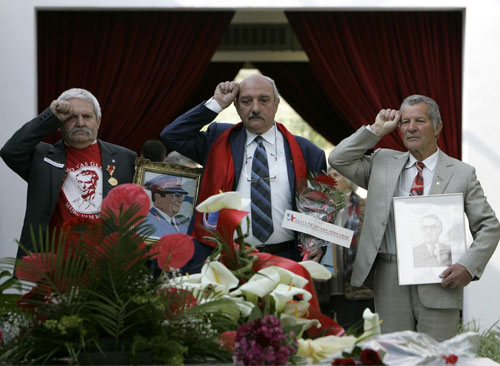

Friday, May 02, 2008
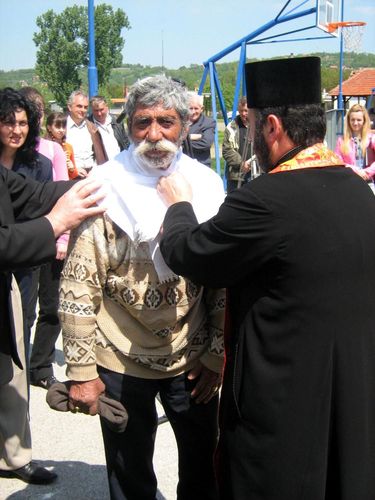
From the chronicles of historicals events: During the elections for the Serbian parliament in 1907 a group of citzens for Cacak organizes as part of the electoral campaign the Baptism of Roma on the city cattle market...
oops I meant 2008.
From B92: Grupa građana Za Čačak u okviru predizborne kampanje organizovala je krštenje Roma na prostoru gradske stočne pijace

oops I meant 2008.
From B92: Grupa građana Za Čačak u okviru predizborne kampanje organizovala je krštenje Roma na prostoru gradske stočne pijace
Thursday, May 01, 2008
Vetevendosije! published in their recent newsletter this wonderful exercise in political correctness... maybe it's time for a regional international talk spell check (when typing FYROM, it automatically adds a footnote stating "
"UNMIK has sent a circular to its staff with the new terminology that they should use. The language to be used clearly indicates UNMIK’s position of hovering indecisively somewhere between Prishtina and
1) The Provisional Institutions of Self-Government (PISG) will now be called Kosova’s institutions or Kosova’s authorities but the use of the term ‘of the Republic of Kosova’ is prohibited.
2) Instead of the word ‘Serbia proper’, only the names of local towns will be used. If the term ‘Serbia’ is used, then a footnote must explain the views of both sides.
3) The term ‘Declaration of Independence’ must not be written with capital letters – because this would give it meaning.
4) The word ‘border’ (which is the standard term indicating an international state border) will still not be used to describe the northern border between Kosova and Serbia. Previously it was called an ‘Administrative boundary line.’ Now it will be called a ‘boundary line’ written in small case letters.
5) Even institutions previously called ‘UNMIK customs’ or UNMIK Railways will not be called Kosova customs, but just ‘customs’.
6) The ‘North’ of Kosova, will now be called ‘northern Kosovo’, and the ‘North’ of Mitrovica will now be called ‘northern Mitrovica’ - The first term is geographic. The second appears to have administrative and political connotations.
7) The process of ‘transition’ of the competences of UNMIK to the PISG and the ICO/EULEX will now be called ‘reconfiguration’ - This indicates merely a change in the structure and organization of the institutions and not the transition of powers from one institution to another. It means that UNMIK is never leaving.
Thursday, April 03, 2008
So Olli Rehn noted today that he wants the Western Balkans to be "normal, prosperous and
boring". The last time somebody promised something similar, it was Vojislav Kostunica, promising a "normal, boring country". I guess this is one election promise he did not live up to. So, Olli Rehn, be warned... maybe a compromise could be found, the Western Balkans slightly more boring and the EU slightly less boring.
Saturday, March 22, 2008
Hilary Clinton discovered in retrospect, how dangerous it was going to Bosnia in 1996... sounds like in five years, she will also remember that she fought of Radovan Karadzic single-handedly after the landing and chased after a horde of assorted war criminals. Describing Bosnia in March 1996 as a war-zone is surely a bit silly (esp. if you are an American). I'd say visiting the US embassy in Belgrade today might be more risky...
Tuesday, March 18, 2008
As part of the British Academy Project which I am working on with Gulnur Aybet and Neven Andjelic, we just launched the project website: http://integratingbosnia.org.uk/.

The fall of a government...
The recent government crisis in Macedonia runs the risk of breaking with the tradition of Albanian party inclusion in goverment since 1990. The technical government in office since the government crisis triggered by the DPA leaving the governing coalition does not include Albanians, as the party refused to rejoin the government, even if only temporary. This reflects a general crisis in the Macedonian-Albanian political relations. Gruevski’s pledge to ignore ethnic politics when coming to office with the VMRO in 2006 has less meant tackling the other challenges Macedonia is facing, but rather ignoring the concerns of the Albanian community and engaging in constant campaigning, which has given him an edge over his main opponent, the SDSM, but alienated him from his coalition partner. New elections run the risk that his party might gain a strong position to form government, but will not facilitate compromise seeking with Albanian political parties. The failure of DPA to deliver during its time in government means that DUI will remain and probably strengthen its role as the strongest party among the Albanian community, resulting in a more difficult coalition forming process than after the last elections in 2006.
Thus, there are serious government and political crises in Bosnia, Serbia, Kosovo and now Macedonia.Saturday, March 15, 2008
How to make a threat...
Confronted with pressure from some EU states to handle banking secrecy more restrictively, Luxembourg's Prime Minister Jean-Claude Juncker, said "I look forward to many years of fascinating, fundamental, discussion." Now here's a way to make a threat. Velja, Kostunica and co., take note.
Confronted with pressure from some EU states to handle banking secrecy more restrictively, Luxembourg's Prime Minister Jean-Claude Juncker, said "I look forward to many years of fascinating, fundamental, discussion." Now here's a way to make a threat. Velja, Kostunica and co., take note.
Friday, March 14, 2008
Headline of the day: Montenegro mobile penetration reaches 175.6 percent. I am not sure how mobile penetration can be more than a 100 percent, but I am not surprised that Montenegro succeeded. I guess everybody has a mobile and three quarters of a second one...
Tuesday, February 26, 2008
According to Kathimerini, Matthew Nimetz has come up with five(!) new suggestions for the name of Macedonia:
Democratic Republic of Macedonia (like Democratic Republic of Congo or German Democratic Republic, generally reserved for, ehm, less democratic state)
Constitutional Republic of Macedonia (as opposed to the unconstitutional of Macedonia?)
Independent Republic of Macedonia (here's a compromise for Kosovo, it just calls itself 'independent' with quotation marks and Serbia pretends to accept it, or maybe the official name of Kosovo could become "Lazna Republika Kosova")
Republic of Upper Macedonia (like Upper Volta, aka Burkina Faso)
I think generally republics should be required to add meaningful adjectives to their names:
"Smallish Republic of Montenegro" (SROCG)
"Kinda Democratic Republic of Serbia" (KDROS)
"Democratic Federal and Sometimes Confederal Republic of Three Equal Constituent People and Nobody Else of Bosnia and Herzegovina" (DFSCRTECPNEBH)
Democratic Republic of Macedonia (like Democratic Republic of Congo or German Democratic Republic, generally reserved for, ehm, less democratic state)
Constitutional Republic of Macedonia (as opposed to the unconstitutional of Macedonia?)
Independent Republic of Macedonia (here's a compromise for Kosovo, it just calls itself 'independent' with quotation marks and Serbia pretends to accept it, or maybe the official name of Kosovo could become "Lazna Republika Kosova")
Republic of Upper Macedonia (like Upper Volta, aka Burkina Faso)
I think generally republics should be required to add meaningful adjectives to their names:
"Smallish Republic of Montenegro" (SROCG)
"Kinda Democratic Republic of Serbia" (KDROS)
"Democratic Federal and Sometimes Confederal Republic of Three Equal Constituent People and Nobody Else of Bosnia and Herzegovina" (DFSCRTECPNEBH)
Monday, February 25, 2008
Forgotten in the whole discussion on the independence declaration of Kosovo has been the news that the Dayton Peace Agreement has been lost. Luckily somebody found it
. Currently the Serbian government is trying to find the independence declaration of Kosovo so that it can be 'lost' to.
. Currently the Serbian government is trying to find the independence declaration of Kosovo so that it can be 'lost' to.
Sunday, December 09, 2007
If you thought that the Department of Records in Brazil mistyping "Buttle" instead of "Tuttle" was one of the worst historic bureaucratic blunders, you're wrong.
In a court case in the Netherlands in which survivors sue the UN and the Netherlands over the genocide in Srebrenica, the UN noted that "its office in Sarajevo refused air support in Srebrenica because the Dutch commander there failed to fill the request form correctly."
Did they cross in the wrong box (please support us with UN navy maritime support) or did they wrongly identify what happened in the form (calling it mass murder prior to an independent UN confirmation based on an extended fact finding mission) or where some signatures missing (of the victims/perpetrators confirming events) ? I'm curious.
In a court case in the Netherlands in which survivors sue the UN and the Netherlands over the genocide in Srebrenica, the UN noted that "its office in Sarajevo refused air support in Srebrenica because the Dutch commander there failed to fill the request form correctly."
Did they cross in the wrong box (please support us with UN navy maritime support) or did they wrongly identify what happened in the form (calling it mass murder prior to an independent UN confirmation based on an extended fact finding mission) or where some signatures missing (of the victims/perpetrators confirming events) ? I'm curious.
Tuesday, November 27, 2007

Monday, November 26, 2007
Monday, November 19, 2007
Here's the bad headline of the day from the IHT: "Early tally gives edge to pro-independence party in Kosovo". So PDK won narrowly over the other parties which are not pro-independence? It is hard to distinguish parties in Kosovo on the issue of political program, but still, emphasizing the only thing which does not set them apart is not exactly a journalistic highlight...
Thursday, November 01, 2007
If you are in Bosnia these days and are not following what's going on, you might be mistaken to think that presidential elections are occurring.
Candidate 1: Sarajevo, last weekend
.jpg) Candidate 2: Banja Luka, last weekend
Candidate 2: Banja Luka, last weekend
 The good news is that there are no elections looming and neither Sanader nor Putin are running in them.
The bad news is that once more some are looking outside the country for help from other outsiders ruling the country.
In fact, the hysteria in RS and Serbia over Miroslav Ljacak's imposition is out of proportion when reading the decision and actually remembering that in the past year more often than not, decisions were not taken in the Council of Minister of Bosnia due to the boycott of Bosniak members.
Never before have RS officials and Serbia react so hostile to any OHR decision over the past 12 years, suggesting that it is not really about the decision, but rather something to do with Kosovo.
See more here
Candidate 1: Sarajevo, last weekend
.jpg) Candidate 2: Banja Luka, last weekend
Candidate 2: Banja Luka, last weekend The good news is that there are no elections looming and neither Sanader nor Putin are running in them.
The bad news is that once more some are looking outside the country for help from other outsiders ruling the country.
In fact, the hysteria in RS and Serbia over Miroslav Ljacak's imposition is out of proportion when reading the decision and actually remembering that in the past year more often than not, decisions were not taken in the Council of Minister of Bosnia due to the boycott of Bosniak members.
Never before have RS officials and Serbia react so hostile to any OHR decision over the past 12 years, suggesting that it is not really about the decision, but rather something to do with Kosovo.
See more here
Thursday, June 28, 2007
Kostunica has the choice to give up Kosovo and choose the heavenly kingdom to follow the example of good old Knez Lazar. As Kostunica noted, a new Kosovo battle is being fought between Serbia and the USA. So Lazar will have the illustrious company of Milosevic and Kostunica keeping him company... Lucky him.
Friday, June 22, 2007

The rest of the article from the BBC website actually made more sense. But as the headline reads, I am expecting a string of follow up articles: "Iran 'urged to finally meet international commitments: Kyoto Protocol or sanctions" or "UN presses Gaza on keeping beaches clean" or maybe "US government warns: Rising problem of fly-tipping in Iraq"
Subscribe to:
Posts (Atom)
